
Dolby Atmos vs Spatial Audio: What Is the Difference?
Dolby Atmos vs Spatial Audio: What Is the Difference?
These two terms appear side by side everywhere — on Apple Music, in headphone marketing, in streaming platform menus. They are used interchangeably so often that most people assume they mean the same thing. They do not. Understanding the difference matters whether you are a listener trying to make sense of your settings, an artist deciding how to release your music, or a producer building an immersive audio workflow.
In this guide:
- The short answer
- What spatial audio actually means
- What Dolby Atmos actually is
- Where they overlap
- Apple’s “Spatial Audio” label explained
- Spatial audio vs Dolby Atmos — which is better?
- What this means for artists and producers
- Frequently asked questions
The Short Answer
Spatial audio is a category — a broad term for any audio technology that creates a three-dimensional sound experience. It is not a specific format, product, or standard.
Dolby Atmos is a specific, proprietary format developed by Dolby Laboratories — the most widely adopted implementation of spatial audio in the world. It is one type of spatial audio, but it is not the only one.
The relationship is analogous to: spatial audio is to Dolby Atmos as “streaming service” is to Spotify. The category contains the product, but the product does not define the category.
What Spatial Audio Actually Means
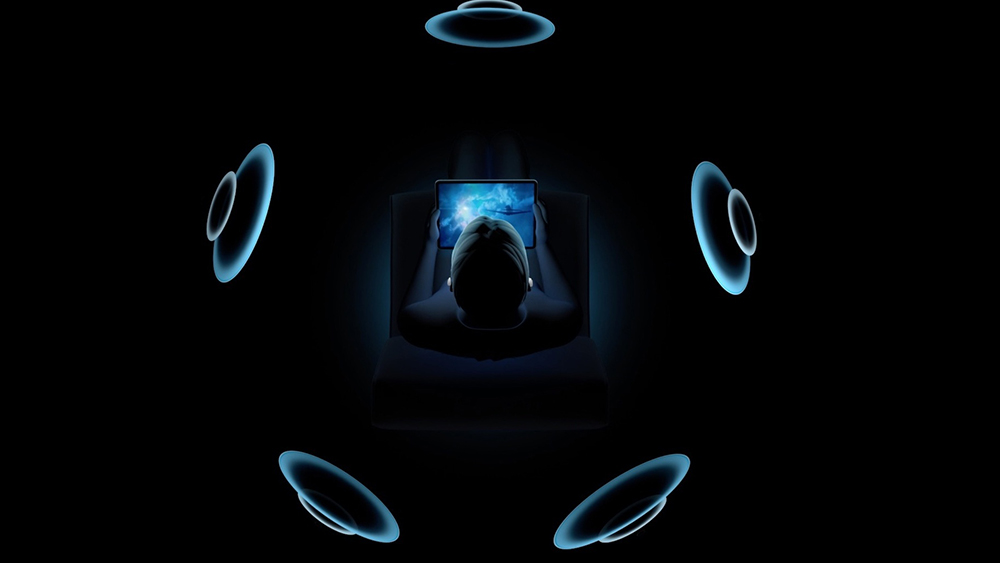
Spatial audio refers to any system that reproduces sound in three-dimensional space around the listener — above, below, behind, and to the sides — rather than from two fixed points (left and right, as in stereo) or a flat ring (as in traditional surround sound).
The defining characteristic of spatial audio is the addition of a height dimension and the ability to adapt to the listener’s playback environment. A spatial audio mix is not locked to a specific speaker count or layout. The same content can be rendered through a 64-speaker cinema array, a living room soundbar, or a pair of earbuds — and each listener gets a spatially correct version of the mix.
Technologies that qualify as spatial audio include:
- Dolby Atmos — object-based, dominant in music and cinema streaming
- Sony 360 Reality Audio — object-based, available on TIDAL and Amazon Music HD
- Ambisonics — spherical audio field encoding, used in VR, 360 video, and broadcast
- Eclipsa Audio (IAMF) — open-source format from Google and Samsung, launching on YouTube and Android 16
- DTS:X — object-based, primarily in home theatre and physical media
- Windows Sonic — Microsoft’s spatial audio solution for gaming on Windows and Xbox
All of these are spatial audio. None of them are spatial audio in its entirety. Read our full overview: What Is Spatial Audio?
What Dolby Atmos Actually Is
Dolby Atmos is a proprietary object-based audio format developed by Dolby Laboratories, first introduced for cinema in 2012 and expanded to music streaming, home entertainment, and gaming in subsequent years.
In an Atmos mix, every sound element — a vocal, a guitar, a sound effect, a room ambience — is treated as an independent audio object with its own three-dimensional position metadata. This metadata tells the Atmos renderer exactly where in 3D space the object should appear: left–right (X axis), front–back (Y axis), and height (Z axis). The renderer places each object through whatever playback system is available, dynamically adapting to the environment.
For music delivery, Dolby Atmos is packaged in an ADM BWF (Audio Definition Model Broadcast Wave Format) file — a single WAV-based container holding all audio tracks and spatial metadata. This is the required delivery format for Apple Music Spatial Audio, TIDAL, and Amazon Music HD.
For a complete technical explanation: What Is Dolby Atmos? The Complete Guide
Where They Overlap
The confusion between the two terms exists for a good reason: in practice, on the platforms most people use every day, spatial audio and Dolby Atmos are almost always the same thing.
- Apple Music’s entire spatial audio catalog is delivered in Dolby Atmos.
- Most premium streaming video on Netflix, Disney+, and Apple TV+ uses Dolby Atmos.
- The majority of cinema spatial audio mixes globally are in Dolby Atmos.
- When headphone manufacturers advertise “spatial audio support,” they almost always mean Dolby Atmos compatibility.
Dolby Atmos is so dominant that for most listeners the distinction between the format and the category is irrelevant in daily use. But it becomes important in three specific situations:
- When choosing between competing formats (Dolby Atmos vs Sony 360 vs Eclipsa Audio)
- When working in VR or 360 video production, where Ambisonics may be a better fit
- When understanding why not all spatial audio sounds the same across platforms
Apple’s “Spatial Audio” Label Explained
Apple uses the term “Spatial Audio” as its consumer-facing brand for the immersive audio experience on Apple Music, Apple TV+, and its hardware products. This has contributed significantly to the widespread conflation of the two terms.
Here is what Apple’s “Spatial Audio” actually refers to, in technical terms:
- On Apple Music — music delivered in Dolby Atmos format, rendered binaurally for headphone listening. The Dolby Atmos ADM BWF master is provided by the label or distributor; Apple’s renderer processes it for the listener’s device.
- On AirPods Pro / AirPods Max — Dolby Atmos binaural playback with the addition of dynamic head tracking. The devices’ motion sensors detect head movement and adjust the audio field in real time, so the sound field stays anchored to the room rather than rotating with the listener’s head.
- On Apple TV+ — Dolby Atmos for compatible content, rendered through the connected audio system.
In short: when Apple says “Spatial Audio,” they mean Dolby Atmos with their own rendering layer on top. The terms are equivalent in Apple’s ecosystem, but not in the broader industry.
Spatial Audio vs Dolby Atmos — Which Is Better?
This question is only meaningful when comparing Dolby Atmos against another specific spatial audio format. As a general comparison, it is like asking whether “a car” is better than “a Toyota.”
If the question is really “Dolby Atmos vs Sony 360 Reality Audio”:
- Dolby Atmos is more widely supported across hardware, streaming platforms, and production tools.
- Sony 360 Reality Audio delivers a comparable listening experience but requires Sony-compatible playback devices for the full effect.
- For most artists and listeners, Dolby Atmos is the practical choice due to its ecosystem reach.
If the question is “Dolby Atmos vs Eclipsa Audio”:
- Eclipsa Audio is royalty-free and open-source; Dolby Atmos carries licensing costs for hardware manufacturers.
- Eclipsa is rolling out on YouTube and Android 16 but has minimal presence in music streaming as of 2026.
- For music production and streaming delivery today, Dolby Atmos remains the only viable choice.
If the question is “Dolby Atmos vs Ambisonics”:
- Dolby Atmos is better for music, film, and streaming content.
- Ambisonics is better for VR, 360 video, and applications where a full spherical capture field is needed rather than placed objects.
DPM Production works across all these formats. See our full service range at dpmsound.com.
What This Means for Artists and Producers
If you are releasing music, the practical answer is simple: you need Dolby Atmos. It is the format Apple Music, TIDAL, and Amazon Music HD use for their spatial audio catalogs. No other format currently delivers the same streaming platform benefits.
There are two ways to get there:
- AI upmixing from your stereo master — fast, free, and accessible. The DPM Spatial Audio Converter converts any stereo file to a streaming-compliant ADM BWF automatically. Full guide: Can AI Create a Dolby Atmos Mix?
- Engineer-led mix from stems — higher quality, full creative control, right for flagship releases. Contact DPM Production for a quote. Our studios in Bratislava and Denver run Pro Tools with calibrated 7.1.4 monitoring.
If you are working in VR, 360 video, or immersive installations, the answer may involve Ambisonics alongside or instead of Dolby Atmos. DPM Sound covers both — explore our immersive audio production services or get in touch directly.
Not sure which format is right for your project? Read: Is Dolby Atmos Worth It for Music?
Frequently Asked Questions
Is Dolby Atmos the same as spatial audio?
No, but they are closely related. Spatial audio is a broad category of technologies that create three-dimensional sound. Dolby Atmos is the most widely adopted specific format within that category. On Apple Music, the two terms refer to the same thing — Apple uses “Spatial Audio” as its brand name for content delivered in Dolby Atmos. In the wider industry, other spatial audio formats exist, including Sony 360 Reality Audio, Ambisonics, and Eclipsa Audio.
Why does Apple call it Spatial Audio instead of Dolby Atmos?
Apple uses “Spatial Audio” as its own consumer-facing brand for the immersive listening experience. The underlying audio format is Dolby Atmos, but Apple layers its own head tracking technology and binaural renderer on top. Using the term “Spatial Audio” allows Apple to describe the experience as a platform feature rather than crediting a third-party format.
Which is better — Dolby Atmos or Sony 360 Reality Audio?
Both deliver comparable immersive listening experiences. Dolby Atmos has significantly broader hardware and platform support — it is available on Apple Music, TIDAL, Amazon Music HD, and virtually all modern AV hardware. Sony 360 Reality Audio is available on TIDAL and Amazon Music HD but requires Sony-compatible devices for the full experience. For most artists and listeners, Dolby Atmos is the practical choice.
What is Eclipsa Audio and how does it compare to Dolby Atmos?
Eclipsa Audio is an open-source spatial audio format developed by Google and Samsung, based on the IAMF (Immersive Audio Model and Formats) standard. It is royalty-free, which makes it attractive to hardware manufacturers who currently pay Dolby licensing fees. As of 2026, Eclipsa Audio is rolling out on YouTube and Android 16. It has no significant presence in music streaming yet. Dolby Atmos remains the dominant format for music production and delivery.
Does head tracking make spatial audio better?
Head tracking significantly improves the spatial realism of binaural audio. Without head tracking, the sound field rotates with your head when you turn it — which breaks the illusion of sounds being placed in the room. With head tracking (as in AirPods Pro), the audio field stays fixed in space as your head moves, making the experience feel far more like being physically present in the sound field. However, spatial audio is meaningfully immersive even without head tracking.
Can I release music in spatial audio without using Dolby Atmos?
Technically yes — Sony 360 Reality Audio is an alternative for TIDAL and Amazon Music HD. However, Apple Music — the platform with the largest spatial audio catalog and the most significant editorial placement benefits — requires Dolby Atmos. For any artist releasing across multiple platforms, Dolby Atmos is the necessary format. The DPM Spatial Audio Converter is the fastest way to create a streaming-compliant Dolby Atmos file from a stereo master.
The Bottom Line
Spatial audio is the category. Dolby Atmos is the standard. In everyday use — on Apple Music, in cinema, on AirPods — the two terms effectively describe the same experience. In professional production, distribution, and platform strategy, the distinction matters: Dolby Atmos is the format you need to deliver, and knowing why separates informed decisions from guesswork.
Further reading:
- What Is Spatial Audio? A Complete Guide
- What Is Dolby Atmos? The Complete Guide
- Is Dolby Atmos Worth It for Music?
- Can AI Create a Dolby Atmos Mix?
Ready to release in Dolby Atmos? Try the free DPM Spatial Audio Converter or contact our team for an engineered mix from your stems.